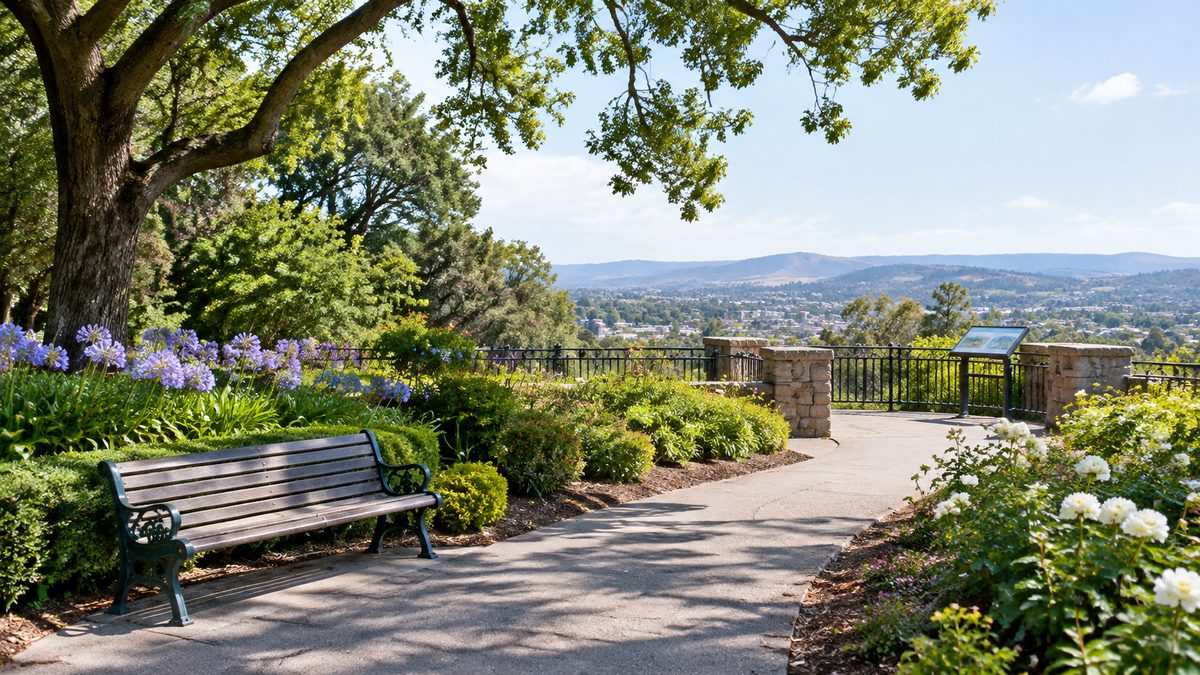
Exploring Rosalind Park: Walking Paths, Gardens and the Lookout
The best way to explore Rosalind Park is to begin near View Street, wander through the lower gardens, then follow the rising paths to the Poppet Head lookout. This route lets the park reveal itself in layers. You move from formal flower beds and shaded lawns to tall trees, old mining ground and broad views across Bendigo. Allow about 60 to 90 minutes for a relaxed visit, longer if you plan to take photos, use the Playground or sit beneath the trees.
Rosalind Park is large enough to feel peaceful, yet it sits beside the centre of Bendigo. Its paths link Pall Mall, View Street and Park Road, so there is no single gate that every visitor must use. The best starting point depends on what you want to see, but a lower-gardens-to-lookout route gives you the clearest sense of the park's shape and story.
Where should you enter for the clearest walking route?
Enter from the View Street side if you want a simple route through the gardens before climbing to the lookout. This side places you close to the lower lawns and established garden beds. It also makes the Poppet Head easy to use as a visual marker. Look uphill through the trees and you can often tell where the walk is leading.
Starting low also gives the visit a natural pace. The first section is gentle and suited to slow walking. The climb comes later, once you have seen the gardens and settled into the park. Visitors who begin near Park Road can reverse the route, but they may meet the steeper ground early and reach the formal garden areas near the end.
Do not worry about following one exact trail. Rosalind Park has a web of intersecting paths rather than a closed circuit. Choose the paths that keep you moving uphill toward the lookout. If you take a side path, it will usually lead back to another main route or lawn.
What are the lower walking paths like?
The lower paths are broad, shaded and easy to follow. Some sections feel formal, with straight lines and framed views. Others curve between trees and open lawns. This mix makes the park work well for visitors who want a short stroll as well as those planning a longer climb.
Roots, fallen leaves and loose gravel can make parts of the route uneven. After rain, shaded patches may stay damp longer than the open paths. Comfortable shoes are a better choice than smooth-soled footwear, even if you plan to remain near the gardens.
At each path junction, pause and look at the slope. A level turn usually keeps you in the lower park. A rising path takes you toward Camp Hill and the lookout. This simple rule is more useful than trying to memorise every bend.
For a gentle visit, make a loose loop through the lower paths and return to View Street. You can enjoy much of the park's shade and garden design without taking on the full climb. This option also suits anyone fitting the park into a short stop between nearby city attractions.
What makes the gardens different from a normal city park?
Rosalind Park was shaped as an English landscape garden, so its character comes from planned views, mature trees, sweeping lawns and curved paths. The design aims to feel natural even where the placement of trees and paths was carefully chosen. You may notice that a path opens onto a lawn, narrows beneath a canopy, then reveals a building or distant feature.
That pattern rewards slow walking. If you rush straight uphill, you miss the changing frames created by trunks, branches and garden beds. Look back as well as forward. Some of the best views appear behind you when the path rises above the lower lawns.
The garden areas also change with the season. Flower displays may draw attention during warmer months, while bare branches can open longer views in winter. Summer shade makes the lawns inviting, but exposed parts of the climb can still feel hot. The park does not depend on one flowering period, because its main features are its scale, tree canopy and layered design.
Many guides treat the gardens as decoration on the way to the lookout. That misses half the experience. The lookout gives you one wide view, while the gardens create many smaller views that change every few steps.
How does the park's gold rush history shape the walk?
The land was used as Government Camp during the Bendigo gold rush. Officials occupied the elevated ground because it gave them a strong position above the busy diggings. That history explains why the upper park feels different from the softer garden areas below.
As you climb, think of the hill as working ground before it became a public retreat. The slope offered oversight of the growing settlement. The Poppet Head later carried the mining character into the park in a visible form. These layers are close together, so the walk moves through civic, mining and garden history within a small area.
The most useful way to read this history is through the land itself. Notice the height of the upper ground, the view toward the city and the direct routes between the hill and central streets. Those details explain the choice of the site more clearly than a list of dates.
Parents can turn this into a simple observation game. Ask children to find the highest point, spot old structures and guess why officials wanted to see across the settlement. That gives the walk a purpose without turning it into a formal history lesson.
How hard is the climb to the lookout?
The climb is short but steady. Most people can complete it by slowing their pace and resting at path junctions. The rise feels sharper after the gentle lower paths, especially on a warm day. Take water and avoid treating the hill as a race.
The easiest approach is to gain height in stages. Follow a rising path, cross or turn at the next junction, then continue upward. A direct line may save distance, but it can feel much steeper. A winding route gives you more shade and more chances to stop.
Wheelchair users, people using mobility aids and families with prams should expect changing surfaces and gradients. The lower park is the easier part of the visit. Access near the upper section may suit some visitors but remain difficult for others. Check local access information before leaving if step-free travel is essential.
One common mistake is reaching the base of the lookout tired because the lower gardens were rushed. Keep an even pace from the start. The climb is much more pleasant when it feels like the next part of the walk rather than a task to finish.
What will you see from the Poppet Head?
The Poppet Head gives a raised view over central Bendigo and the land beyond it. From this height, the city's layout becomes easier to read. Church spires, civic buildings, rooftops and tree-lined streets rise above the closer canopy.
A poppet head is a mining structure once used above a shaft to support the movement of workers and ore. Its form fits Bendigo because mining shaped the city beneath the surface as well as above it. At Rosalind Park, the structure now works as a lookout and a strong visual link to that history.
Climb at a calm pace and keep children close on the stairs and platform. Wind can feel stronger above the trees. Once at the top, move around the viewing area instead of stopping at the first opening. Each side gives a different view, from the close city centre to the wider horizon.
Late afternoon often brings softer light across buildings and trees. Morning can be quieter and cooler. The middle of a clear summer day gives strong visibility, but the exposed lookout may feel harsh. Weather matters more at the top than it does beneath the garden canopy.
Where can families pause during the visit?
Use the lawns as planned rest points rather than waiting until someone becomes tired. A short stop before the climb gives children time to reset. Another stop after returning downhill turns the walk into an easy outing instead of one long push.
The Playground can be useful for families who need active play between slower parts of the visit. Set expectations before starting. Explain whether play comes before the lookout or after it. This avoids the familiar problem of children believing the walk has ended as soon as they see play equipment.
Choose a meeting point if older children are moving ahead. A large tree, path junction or visible park feature works better than a vague instruction to meet near the gardens. The network of paths can make people appear farther apart than they are.
For food, bring something simple that produces little waste. The park suits a snack or picnic, but it is still a shared civic space. Carry rubbish out if nearby bins are full. Keep food packed during the climb so hands remain free on steeper ground and stairs.
How can you avoid missing the best details?
Walk one way uphill and choose a different path down. The park changes with direction. On the ascent, your eye follows the slope and the Poppet Head. On the return, the city and lower gardens open in front of you.
Look for the transition between formal planting and rougher upper ground. That change tells the park's story. The lower section expresses the English landscape garden plan, while the upper section keeps a stronger link to Government Camp and mining history.
Use the edges of the park to understand its place in the city. View Street connects the green space with Bendigo's cultural area. Park Road marks another useful approach to the upper grounds. These streets make it easy to include the park in a central visit, but the walk remains more rewarding when it has its own time rather than being treated as a shortcut.
Listen as well as look. Traffic is more noticeable near the outer streets. Bird calls, wind in the canopy and footsteps take over deeper inside. That quick shift is part of the park's appeal. You can still be near central Bendigo while feeling removed from its busiest blocks.
What should you bring for a comfortable walk?
Wear shoes with grip and carry drinking water. Add sun protection because the upper ground and lookout are more exposed than the shaded lawns suggest. A light layer helps on cool or windy days, especially if you plan to spend time at the top.
Keep your bag small. You will enjoy the lookout stairs more with both hands free. A phone or compact camera is enough for most visitors because the strongest images come from position and light, not special gear.
Check the weather before setting out. Heavy rain can change path conditions, while extreme heat makes the climb harder. Public events may also affect access to parts of the wider park precinct. Signs at entrances should guide your route if a section is closed.
How should you plan the full visit?
Set aside 60 to 90 minutes and follow a simple order. Enter near View Street, explore the lower garden paths, pause on the lawns, then climb gradually toward the Poppet Head. Spend time at the lookout before returning by a different path. Families can place the Playground stop where it best matches children's energy.
Do not measure the walk by distance alone. Rosalind Park works because several kinds of experience sit close together. The gardens reward detail, the hill explains the site's history and the lookout reveals the city as a whole. Moving slowly lets each part feel distinct.
Start from View Street, follow the gardens uphill to the Poppet Head, and return on a different path so you see both sides of Rosalind Park.